




Your Voice Matters: Key Legislative Hearings You Should Know About

By Julie Schurman, Director of Public Policy, The Arc & UCP California Collaboration

As California moves forward with key budget decisions and legislation, several important hearings in the coming days and weeks could directly impact people with developmental disabilities, their families, and the professionals who support them. These proposals include potential cuts to essential services like In-Home Supportive Services (IHSS) and Medi-Cal Dental, as well as legislation that strengthens protections and advances equity for our community. Now is the time to stay informed and engaged. While public testimony must be given in person, there are still meaningful ways to participate—by submitting comments via email, calling committee members and tuning in to watch the hearings live. Your voice matters, and policymakers do pay attention.

Wednesday March 25: Governor’s Proposed Cuts to IHSS

ABOUT IN-HOME SUPPORT SERVICES (IHSS) CUTS:

California is considering a set of proposals that would significantly change the In-Home Supportive Services (IHSS) program by removing key protections and shifting costs in ways that could limit access to care. In response to reduced federal funding tied to H.R.1, the state is looking for ways to reduce spending—putting critical IHSS supports at risk for those who depend on them.

One proposal would eliminate the IHSS Backup Provider Program, which helps ensure individuals continue receiving care if their regular caregiver is unavailable. Without this support, people could be left without assistance for essential daily needs.

Another proposal would end the IHSS Residual Program, which currently allows individuals to continue receiving services for a limited time if their Medi-Cal coverage is interrupted due to administrative issues or eligibility changes. Removing this safeguard could result in an abrupt loss of care.

Additional changes would shift the full cost of increased IHSS service hours to counties, creating financial pressure that could lead to reduced services and uneven access to care across different parts of the state.

POSITION: Oppose Cuts

HEARING DETAILS: Wednesday, March 25 at 1:30 p.m. at State Capitol, Room 444 (enter on L Street). Public comment at the end of the hearing, which could go past 5:00 p.m. Click HERE for full agenda.

WAYS TO GET INVOLVED:

    • Email Assembly Budget Committee with your public comment opposing these cuts to: AsmBudget@asm.ca.gov – Click HERE for sample messaging.
    • Attend hearing in person and participate in public comment at the conclusion of the hearing.
    • Watch Livestream available here

Thursday, March 26: Medi-Cal Dental Budget Cuts 

ABOUT MEDI-CAL DENTAL CUTS: The Governor’s proposed budget includes nearly a $1 billion cut to Medi-Cal Dental, about one third of the program’s total funding. If approved, payments to dentists who accept Medi-Cal would drop by 40 percent to 80 percent, depending on the service. In a recent survey, more than half of dentists said they would stop accepting Medi-Cal patients or reduce the care they provide. These cuts are set to take effect on July 1, 2026. Reducing the program by this much would severely weaken California’s dental safety net, putting access to care at risk for roughly 15 million people who rely on Medi-Cal Dental

POSITION: Oppose Cuts. 

HEARING DETAILS: Thursday, March 26 after 9:30 a.m. (may start in afternoon): Senate Budget Sub 3 at the Senate Swing Space (1021 O St, Sacramento, CA, Room 1200). This agenda item may not be heard until early afternoon and run until 5 p.m.  Public comment is at the end of the hearing.  Click HERE to view agenda.

WAYS TO GET INVOLVED:

Click HERE to learn more.

Monday, April 6: SB 1052 – SCDD Authorized Representatives

ABOUT SB 1052 (Gonzalez).  SB1052, introduced by Senator Lena Gonzalez, strengthens and clarifies Welfare and Institutions Code §4541 to ensure continuity of authorized representation for individuals with developmental disabilities served by regional centers. SB 1052 modernizes and clarifies the statute governing Authorized Representatives, which is a critical safeguard that protects civil rights when an individual with disabilities does not have a parent, guardian, or conservator legally authorized to assist them. Co-Sponsored by The Arc of California, State Council on Developmental Disabilities (SCDD), the Integrated Community Collaborative, and Disability Voices United.

POSITION: Support

HEARING DETAILS: Monday, April 6 after 3 p.m. at in Senate Health Services Committee at Senate Swing Space: 1021 O Street, Room 2200

WAYS TO GET INVOLVED:

Click HERE to learn more.

Tuesday, April 7 — AB 2347  Commission on Peace Officer Standards and Training

ABOUT AB 2347 (Ahren).  Existing law defines a “hate crime” as a criminal act committed, in whole or in part, because of actual or perceived characteristics of the victim, including, among other things, race, religion, disability, and sexual orientation. Existing law requires the Commission on Peace Officer Standards and Training (POST), in consultation with specified subject-matter experts, to develop guidelines and a course of instruction and training for law enforcement officers addressing hate crimes. Existing law also requires POST to consult with the subject-matter experts if the guidelines or course of instruction are updated. Beginning January 1, 2027, AB 2347 would require POST to conduct a comprehensive review of existing hate crimes training programs, as specified. The bill would require the review to be completed by January 1, 2028. The bill would require POST to, by July 1, 2028, adopt evidence-based training requirements to address the gaps identified in the review regarding the prevention, identification, and investigation of hate crimes.

POSITION: Support

HEARING DETAILS: Tuesday, April 7 at 8:30 a.m. in Assembly Public Safety Committee hearing at the State Capitol in Room 126

WAYS TO GET INVOLVED:

Click HERE to learn more.

Thank you to everyone in our community who continues to speak up, share your experiences, and stay engaged in the policymaking process. Advocacy takes time and effort, and your voice plays a critical role in shaping decisions that affect services, supports, and rights across California. Whether you attend a hearing, submit a comment, or simply stay informed, you are helping build a stronger, more inclusive future for all.

Tips for Being a Successful Advocate

By Jim Frazier, Public Policy Director, The Arc / UCP California Collaboration

As an elected official, I was approached thousands of times by folks who wanted me to support their position on an item or cause.  I always appreciated their passion and willingness to educate me on specific issues.  Here are my takeaways and tips on how you can be an effective advocate who educates, informs, and inspires support from your local or statewide elected official:

    • Attend a lobby day with an advocacy organization or nonprofit that is advancing the cause you care about or attempting to influence policy or legislative changes;
    • Schedule an appointment with the elected official’s office and specifically ask to meet with that official;
    • Bring current and accurate information about the subject matter to leave behind in a folder with a label.  Include your contact information, a fact sheet or data that supports your cause, case studies, or personal stories from constituents;
    • Share your story with meaning and passion.  Explain how the issue impacts the broader community of constituents and suggest how you would like the elected official to address, support, or respond;
    • Ask them if they have any questions or need more information.  How can you be of ongoing support to them?;
    • Suggest next steps and follow-up timeline.

Additionally, you can invite the elected official to attend local meetings or events where more community members support the issue.  It’s essential to assess how they feel about the topic after you present them with the information.  Find out if there is a personal connection to the issues.  Taking an interest in them shows your willingness to support them; that goes a long way.

After meeting your elected officials, plan to attend their events, town halls, and coffee meetings with as many advocates supporting your cause or issue as possible.  Showing a presence can be very influential.  Doing so keeps your issue fresh in their memory.  In all fairness, elected officials can sometimes feel pulled in several directions at once.  Become a partner with them and see your effectiveness as an advocate grow and the relationship flourish.  It does take a village.

When the next budget session starts in August, we will be calling on the disability community of self-advocates, family members, direct support professionals, and those who care about the disability population to join the disability rights movement as advocates.  You can sign up for our Action Alerts and be ready to take action at https://thearcca.org/advocacy/take-action/

20 United States Senators Push for Disability Specific Relief in Next Covid-19 Stimulus Package

In response to constant advocacy efforts by the disability community, a bi-partisan letter signed by 20 U.S. senators was sent to congressional leadership requesting disability specific funding in the next stimulus bill. The letter proposes a $50 billion increase in funding for Medicaid Home and Community-Based Services (HCBS) programs, paid sick leave for people with disabilities and their caregivers, a boost in Medicaid funding, and emergency income relief. The letter also calls for a 12% increase in the Medicaid matching rate and calls for the permanent reauthorization of Money Follows the person.

A copy of the letter can be read here.

What Do You Need? What Do You Want?

A basic definition search of the difference between needs and wants turned up the following “The difference between needs and wants is really quite simple; need is something you have to have and want is something you would like to have.” The explanation that followed went on to say that “In actuality, a person only NEEDS four things to survive which include; a roof over your head, enough food and water to maintain health, basic health care and hygiene and enough clothing to remain comfortable.” Perhaps that is true for most people but what about a person with an intellectual or developmental disability who NEEDS their direct support professional (DSP)? For thousands of people with I/DD basic needs are more far-reaching than a roof over their head, enough food and water, basic health care and clothing, yet many of the services provided by DSPs are often treated as wants rather than needs.

For some people, the ability to meet their most basic needs depends entirely on having a quality DSP who knows what their actual needs are. What happens to meeting a person’s most basic needs when the person they need just can’t afford to do it? Do you tell them “I would love to support your efforts to get out of bed today, to get dressed today, to go to the bathroom today, to eat today, to get to work today… and on and on… BUT I just can’t afford to do that.” The services and supports provided by DSPs are not luxuries they are necessities. If DSPs really are the “BACKBONE” of our system, as we have heard so many people say, then let’s treat them like it. Let’s RALLY and make some noise and keep making noise until we are so loud that we can’t be ignored. This is a CALL TO ACTION for everyone who is, knows, needs and values DSPs to join us in advocacy efforts to address the DSP Workforce Crisis because LIVES DEPEND ON IT! There are so many ways to get involved and make a difference in advocating for a strong DSP Workforce. The ANCOR FOUNDATION and UNITED CEREBRAL PALSY have published the 2019 Report The Case for Inclusion in which they highlight the magnitude of the DSP Workforce Crisis. Read it, become knowledgeable about the problem and advocate!

Upcoming Advocacy Opportunities:

April 2, 2019, 6:00 PM, Sacramento

Red Carpet Film Premiere Event INVALUABLE – The Unrecognized Profession of Direct Support

Free and Open to the Public Crest Theater 1013 K Street Sacramento, CA 95814

*Please RSVP to Mark Melanson by March 29th at mmelanson@toolworks.org

April 3, 2019, 10:00 AM – 2:00 PM, Sacramento

Keep the Promise Rally

10:00 – 10:30 AM: Arrive at the Crest Theatre 1013 K street, Sacramento, CA

10:30 – 11:15 AM: Speakers

11:15 – 12:00 PM: March around the State Capitol Building

12:00 – 1:00: Rally at the State Capitol Building

April 5, 2019, 11:30 AM – 1:00 PM, San Diego

Keep the Promise Rally

11:30 AM: Arrive at State Building, 1350 Front St. San Diego, CA

12:00 – 12:30 PM: Speakers

1:00 PM: Conclusion

April 5, 2019, 12:00 – 1:30 PM, Los Angeles

Keep the Promise Rally

12:00 1:30 PM: Events at Van Nuys State Office Building, 6150 Van Nuys Blvd. Van Nuys, CA

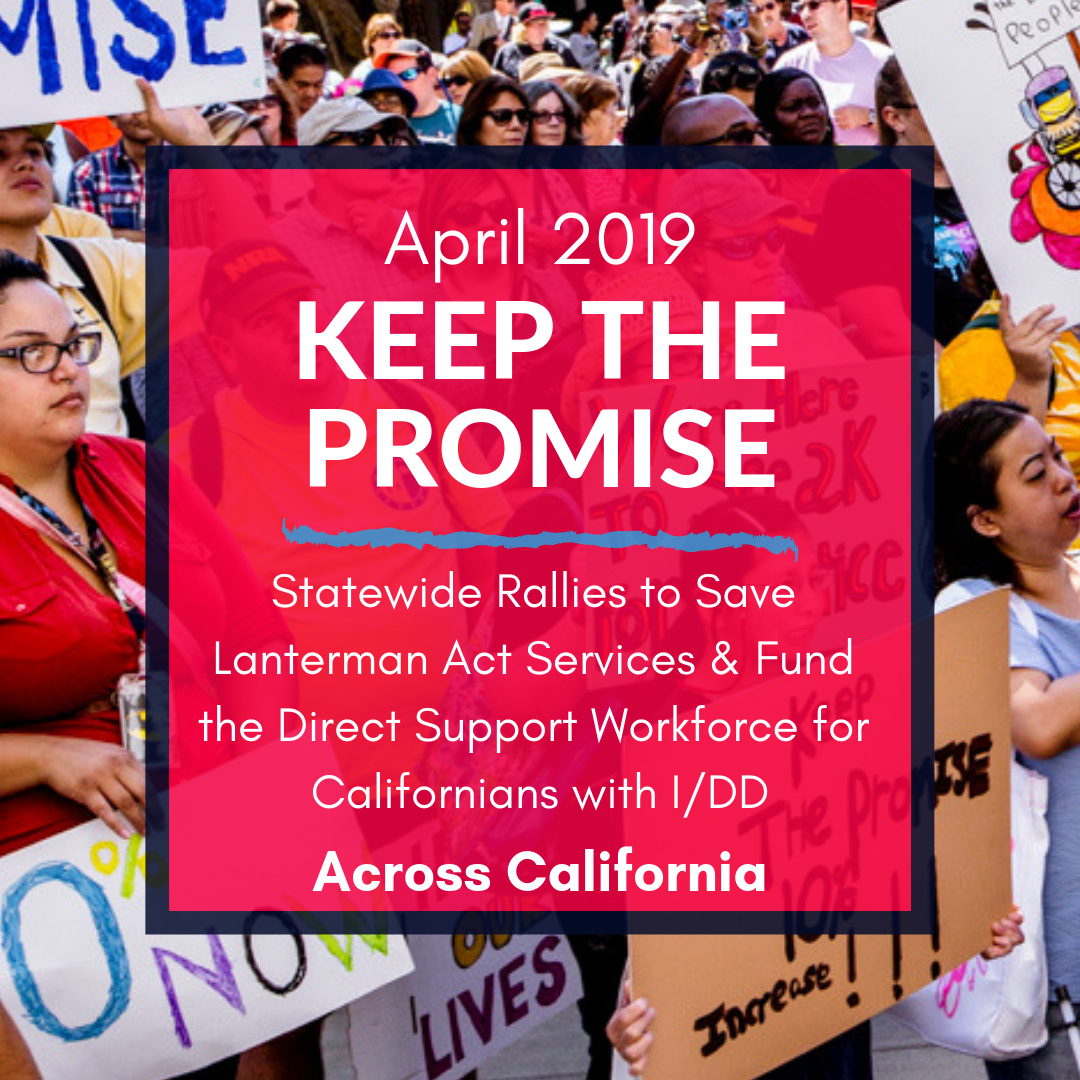
April Statewide #KeepThePromise Rallies for Californians with I/DD

This April will see three rallies across the state in support of the intellectual and developmental disability (I/DD) community. These rallies are an important part of a statewide effort to demand that our lawmakers increase funding to the system of services and supports people with I/DD rely on; a system that is grossly underfunded.

Click on the locations below for informative, shareable flyers and come out to a rally near you!

To learn more about the budgetary issues facing the I/DD community and other ways that you can get involved, visit thelantermancoalition.org.

#KeepThePromise

1. The Rally:

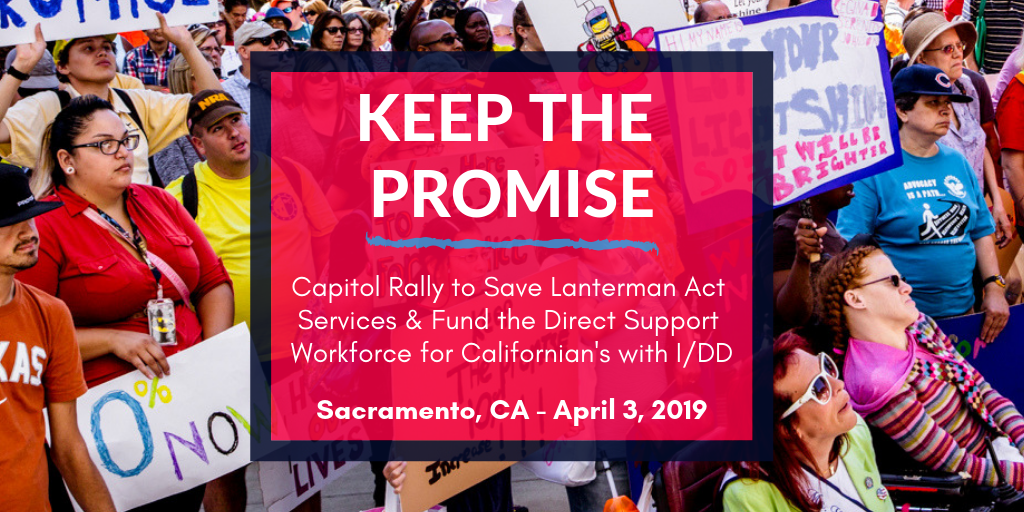
Join us in Sacramento on April 3, 2019, for the #KeepThePromise Capitol rally to save Lanterman Act services & fund the direct support workforce for Californian’s with intellectual and developmental disabilities (I/DD).

More than 330,000 Californians with I/DD live in our state – they are our neighbors, classmates, coworkers, family, and friends – however, their support structure has been grossly underfunded and is failing. Direct support staff are quitting the field or working multiple jobs due to low wages, essential programs are closing throughout the state, and individuals are forced to live with inadequate supports or with no support at all.

California’s lawmakers must fund the services and supports people with I/DD rely on to access their civil rights. An 8% increase will provide emergency stabilization which our community desperately needs.

For the full schedule of rally events, visit theLantermanCoalition.org/rally or download our shareable flyer.

2. Engage Your Legislators:

3. Share:

Visit thelantermancoalition.org’s social media tool kit and share any of our premade social media posts to let your network know that California’s lawmakers must #KeepThePromise to the I/DD community.

4. Stay Involved – #KeepThePromise on Twitter:

Twitter is a social media tool which allows us to communicate directly with each other and our lawmakers.

  • If you aren’t already on Twitter visit our social media toolkit to learn how to sign up, and how to use your account for online advocacy
  • Follow The Lanterman Coalition’s Twitter account
  • when you tweet about the budget remember to use #KeepThePromise so that other budget advocates can find you and share your tweet