





New State Plan Aims to Transform Law Enforcement Response to People with Disabilities

By Greg deGiere, Civil Rights Advocate, The Arc of California

A sweeping new statewide plan released by California Attorney General Rob Bonta could significantly improve how law enforcement interacts with people with intellectual and developmental disabilities and mental health conditions—interactions that too often escalate with harmful or tragic outcomes.

The plan is the result of two years of work by a statewide advisory council created through Senate Bill 882, sponsored by The Arc & UCP California Collaboration, the Association of Regional Center Agencies, and the United Domestic Workers, and authored by former Senator Susan Eggman.

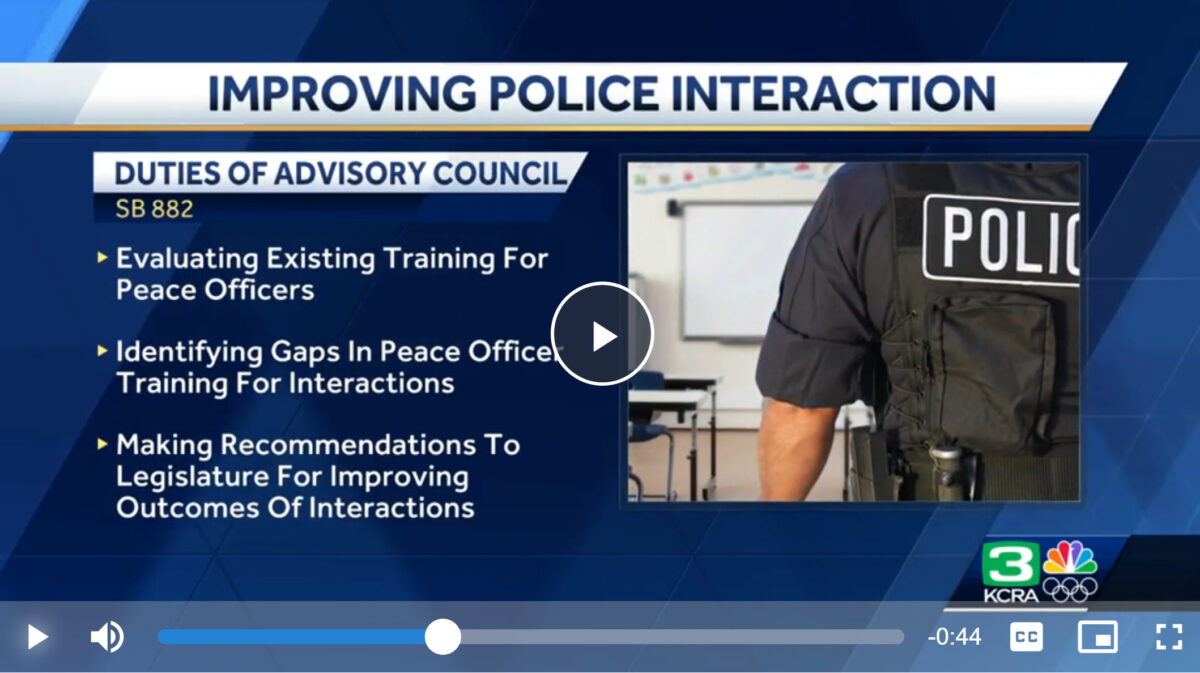
The council’s 85-page report outlines a roadmap for change, calling on the Legislature, the Commission on Peace Officer Standards and Training (POST), and the Department of Developmental Services to act on:

      • Expanded and alternative crisis response models;
      • Systemwide interventions to reduce escalation;
      • Improved training through regional centers and the Department of Education.

California Department of Justice (DOJ) released a summary of key recommendations, alongside the full report and appendices.

“Existing research shows that people with mental health conditions or intellectual and developmental disabilities are more likely to have potentially heightened or escalated interactions with law enforcement,” Bonta said in a press release by the DOJ. “This report represents a critical step forward in improving those responses through data-driven solutions.”

For example, one study indicated that 19.5% of youth with autism in the United States had been stopped by police by age 21, while another study indicated that comparatively, only 10% of the general population in the United States had experienced police contact in 2020. Statistics like these demonstrates the need for reforms.

The advisory council was led by Chair Jim Frazier, former Assemblymember and Director of Public Policy for The Arc of California, and Vice Chair Astrid Zuniga, President of the United Domestic Workers and Chair of the California Democratic Party’s labor caucus. The council includes leaders across disability, mental health, labor, aging, education, and public safety sectors.

“I want to make sure that when this report goes out, we pursue it to ensure that it is followed up on. There are still gaps,” said Council Chair Frazier. “Society has always undervalued the SB 882 population, but if you spend any time with people in this population, you know that they are important members of our communities and deserve our respect.”

The recommendations will take sustained legislative and systems change to implement, and advocacy efforts are already underway to move them forward. With strong support from the Attorney General’s office, there is growing momentum to turn these recommendations into real-world impact. We will keep you updated on any new developments.

Click HERE to view report.

SB 882 Advisory Council Continues Public Meetings on Improving Interaction Between Law Enforcement and People with Disabilities

By Jim Frazier, Director of Public Policy, The Arc & UCP California Collaboration

On October 18, the SB 882 Advisory Council that I am honored chair met to discuss ways to improve interactions between law enforcement and people in the developmental disabilities and mental health communities. We continued the process of engaging with subject-matter experts who are involved with the implementation and training of law enforcement and first responders.

The Council asked many questions about training methods, including where improvements could be made to training materials or time spent on training. I personally suggested engaging with school campus officers, special educators and parents for their feedback. I’m looking forward to engaging with so many more stakeholders in the disability community to receive their feedback and perspective on how interactions might improve.

There is a public comment opportunity during the meeting that can be accessed virtually, and I encourage all of you to share your experiences with the Council. The next Council meeting link and date will be posted soon. I look forward to continuing these invaluable conversations, and developing a full report and recommendations to the Legislature. Here is the SB 882 website to look at past meeting agenda’s and minutes.

SB 882 Advisory Council Meeting Featured Subject Matter Experts to Inform the Development Law Enforcement Training Modules

By Jim Frazier, Director of Public Policy, The Arc & UCP California Collaboration

On July 25 the SB 882 (Eggman) Advisory Council on improving interactions between people with developmental disabilities and law enforcement met for the second time.

The meeting, hosted by the California Department of Justice, was open to the public, and Councilmembers had the option of attending remotely or in-person. Subject matter expert Teresa Anderson, Executive Director of the California Policy Center on Intellectual and Developmental Disabilities, presented her suggestions for various experts to include in future meetings, and credible sources for gathering data. Teresa, who has 30+ years experience in working with the disability community, provided valuable insights and was an incredible resource to the advisory council.

Three members from Commission on Peace Officer Standards and Training (POST), Legislative Liaison Megan Poulos, Bureau Chief Michael Radford and William Baldwin of Mental Health Training Services, shared their recommendations for developing curriculum modules for law enforcement trainings to improve public safety when interacting with individuals with a developmental disabilities. It was noted that there were no training provisions for individuals that are sight or hearing impaired. Staff said it wasn’t a mandate and therefore not included. This finding affirms the usefulness of the council to provide suggestions on how best practices can be improved.

In addition to myself, councilmembers include Rick Braziel, Olwyn Brown, Beth Burt, Lauren Libero, Christina Petteruto, Clifford Phillips, Emada Tingirides, and Astrid Zuniga.

The meeting was live streamed and over 20 people from the public attended virtually and provided helpful comments to guide the council. Look out for more updates when the next SB 882 Advisory Council reconvenes.

SB 882: Advisory Council on Improving Interactions between People with Disabilities and Law Enforcement Holds First Meeting

By Jim Frazier, Director of Public Policy, The Arc & UCP California Collaboration

Last week, the SB 882 Advisory Council on Improving Interactions between People with Intellectual and Developmental Disabilities and Law Enforcement were sworn in and conducted their first meeting. I am proud to be one of the council members appointed by Anthony Rendon, Speaker Emeritus of the California State Assembly

The Advisory Council is composed of nine members appointed by the Governor, Senate Committee on Rules, and Speaker of the Assembly, all with very impressive credentials. After being sworn in, we got straight to work. We made suggestions on the type of data, information and presentations from community stakeholders and subject matter experts that would be needed for the council to make recommendations to the legislature on possible policy changes or updates to existing legislation to address to improve the outcomes between the disability community and law enforcement.

KCRA News 3 included the public meeting in its newscast highlighting the importance of the landmark legislation that was sponsored by The Arc & UCP California Collaboration, United Domestic Workers/AFSME Local 3930, and the Association of Regional Center Agencies.

The meetings are open to the public and we encourage stakeholder participation and input as we continue the planning and strategic recommendation process. The more input we have from the community, the better the outcome. To watch the first meeting, view the list of Councilmembers, or provide input by email or joining the next meeting, visit the website at sb882@doj.ca.gov.