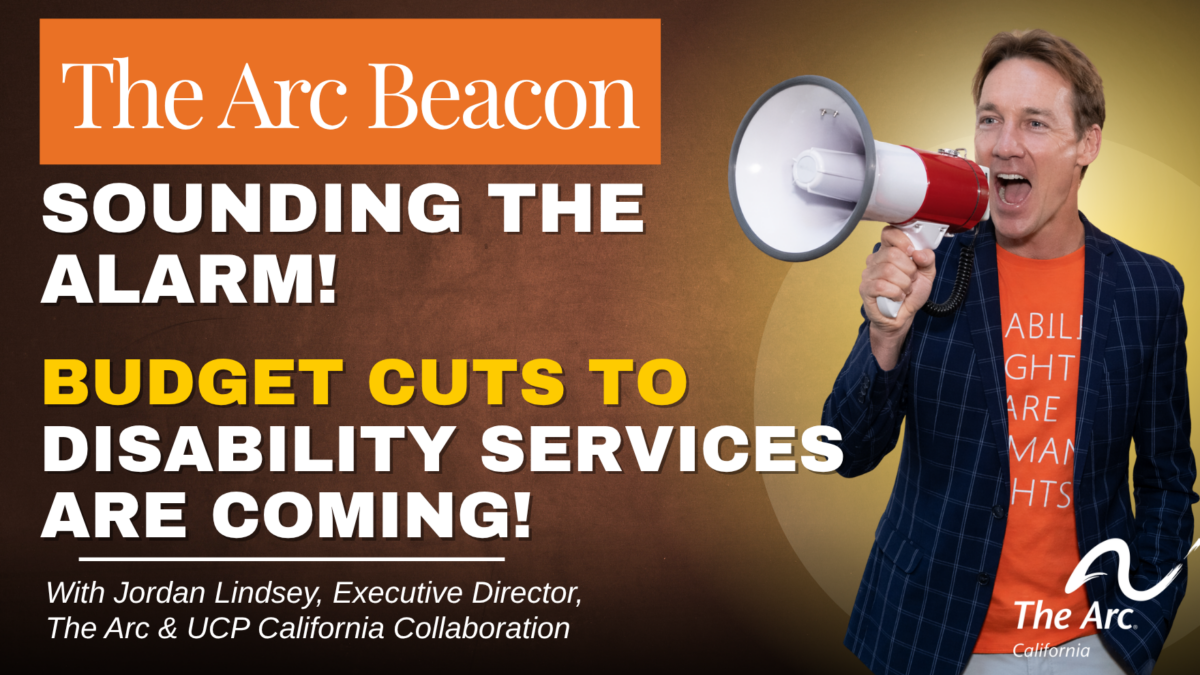
Arc Beacon: Sounding the Alarm

By Jordan Lindsey, Executive Director, The Arc & UCP California Collaboration

We expect the Governor’s May Revision of the California State Budget will include deep and harmful cuts to critical developmental services and supports that more than 500,000 Californians with disabilities and their families rely on every day. Decisions by our legislators to accept or reject the Governor’s proposed budget cuts will move quickly. And if our community is not visible, not organized, and not speaking up—those decisions will be made without us.

Click HERE to watch a 3-minute video message to learn more about what’s at stake and how you can get involved and make a difference.

Then Take Action: Show up on May 19

Join us in Sacramento for the DisCo at the Capitol: California Disability Community Advocacy Conference and Rally.

📅 Tuesday, May 19

📍 California State Capitol

🎟️ FREE to attend (lunch included)

⚠️ Registration required — closes in one week

This is California’s premier gathering for the disability community, and this year, it is more important than ever! The Event if FREE thanks to our generous sponsors, but registration is required to attend.

Hundreds of advocates will meet directly with legislators to:

      • Share personal stories
      • Urge them to reject cuts to essential services
      • Remind them to Keep the Promise of The Lanterman Act

Be Part of this Historic Moment

We’re bringing together advocates, families, and leaders from across the state, along with an inspiring lineup of speakers and changemakers.

This is about protecting independence.

This is about preserving essential services.

This is about making sure our community is heard.

Register now at discoatthecapitol.org

California’s 2025-26 Budget: What It Means for People with Disabilities

Governor Gavin Newsom’s initial January budget proposal was a relatively status quo budget; however, his May Revise budget proposed drastic cuts to important programs for Californians with disabilities, including Medi-Cal and In-Home Supportive Services (IHSS). According to the Governor and the Legislature, this year, California faced a significant budget shortfall driven by three key factors:

    • First and foremost, the policies of the new federal Administration – in particular the tariff increase policies – have caused economic forecasts throughout the world to be significantly downgraded. The federal policies have greatly impacted California’s economic forecast as well, with the May Revision projecting slower growth and the Newsom Administration indicating that federal economic policy changes have reduced state General Fund revenues by $16 billion. The state budget condition may be further adjusted downward based on additional adverse federal policies in the coming weeks and months, such as major cuts to Medicaid.
    • Second, to a modest degree, the baseline costs of key programs – particularly Medi-Cal – have grown faster than projected.
    • And third, to a smaller degree, the devastating LA fires have had a negative economic impact and resulted in increased state spending.

In response to Governor Newsom’s proposed cuts, the Legislature successfully pushed back against most of the drastic reductions to health and human services programs. The final state budget signed by the Governor represents a negotiated compromise. In the end, the proposed 2025-26 California state budget plan includes $228 billion of spending from the state’s General Fund in 2025-26, an estimated $89 billion of special fund spending, and $4 billion of spending from bond accounts. In addition, as of the May Revision, $174 billion of federal funds spending was projected to flow through the state treasury, but that amount may change significantly based on actions by Congress and the White House.

The Arc & UCP California Collaborative has provided the following detailed summary of California’s enacted 2025-26 budget and its impact on people with intellectual and developmental disabilities and their families:

REGIONAL CENTER SERVICES

    • Service Provider Quality Incentive Payment: Approves the May Revision proposal regarding the Provider Mandates for Quality Incentive Payment Eligibility. Includes a reduction of $221.7 million General Fund in 2026-27 and ongoing associated with requiring compliance with Electronic Visit Verification, financial review/annual audits, and Home and Community-Based Services (HCBS) rules as a pre-condition for eligibility of the quality incentive component of the rate models.
    • Rate Model Implementation, Hold Harmless: Approves the May Revision proposal regarding the Service Provider Rate Reform Hold Harmless Provision. Approves a reduction of $75 million General Fund in 2025-26, and a decrease to reimbursements by $37,952,000, one-time to end service provider rate reform hold harmless policy as of February 28, 2026, instead of June 30, 2026.
    • Self-Determination Program: Approves a reduction of $22.5 million General Fund in 2025-26, and $45.5 million General Fund ongoing by making various changes to the Self-Determination Program, including, among others, establishing the participants’ individual budget generally based on the services authorized instead of being based on purchase of service expenditures, requiring a regional center to certify that participants’ spending plans satisfy certain criteria, and requiring the department to establish statewide standardized processes and procedures for the program, with community input, no later than March 1, 2027.
    • Tailored Day Services: Existing law requires the hourly rate for the tailored day service option to be calculated in a specified manner. The budget will end use of the above-described calculation methodologies on June 30, 2025, and, commencing on July 1, 2025, would require the hourly rate for the tailored day service option for vendored programs to be set by the department and posted on its internet website.
    • Direct Support Professional Training (aka DSP University): Rejects the Governor’s May Revision proposal to eliminate the Regional Centers Direct Service Professional Workforce Training and Development Program.
    • Repeal of Regional Center Monthly Parental Fee: The budget repeals the existing monthly parent fee, which currently requires the department to assess a monthly fee to parents of children under 18 years of age who are receiving 24-hour out-of-home care services through a regional center or who are residents of a state hospital when the family’s gross income is above 200% of the federal poverty level, as specified.
    • Supported Employment: Existing law sets the hourly rate for supported employment services provided to consumers receiving individualized services and for group services at $36.57 and requires job coaching hours for group services to be allocated on a prorated basis between a regional center and the Department of Rehabilitation when consumers are served in the same group. Existing law also requires that a new work activity program receive the statewide average rate, as determined by the department. The budget removes the hourly rate for both supported employment services and group services and would instead require the department to set a rate and post the rate to its internet website. The bill would also remove the requirements that job coaching hours for group services be allocated on a prorated basis and that a new work activity program receive the statewide average rate, and would instead require that the program receive the rate posted on the department’s internet website.
    • Health & Safety Waiver Assistance: Approves the May Revision proposal regarding Health and Safety Wavier Assistance. Approves a reduction of $3.0 million General Fund in 2025-26, with reimbursements to decrease by $1,412,000, and ongoing for resources related to providing consumers and families assistance in applying for health and safety waivers. Approves associated, corresponding trailer bill language.

MASTER PLAN ON DEVELOPMENTAL SERVICES

This bill would require the Master Plan for Developmental Services Committee to meet at least 2 times each year, as specified, and would set forth the information to be included in the initial report and recommendation updates, including, among other things, a narrative summary of the master plan committee meetings.

IN-HOME SUPPORTIVE SERVICES (IHSS):

    • Approves $3.3 million and adopts trailer bill language that would require the Department of Human Resources, in collaboration with the State Department of Social Services, to appoint a statewide bargaining advisory committee to review the full cost of care for IHSS provided through the IHSS program under a statewide collective bargaining model. Authorizes $3.3 million for funding one-time from the General Fund.
    • Rejects the May Revision proposal regarding In-Home Supportive Services (IHSS) Provider Overtime and Travel Hours.
    • Rejects the May Revision proposal regarding In-Home Supportive Services for Undocumented Adults.
    • Modifies the May Revision Proposal to require the asset test limit as it was in the prior interim step, which permitted assets up to $130,000 for individuals and $195,000 for couples, that was in effect from July 1, 2022 to December 31, 2023, starting January 1, 2026, consistent with the same change in Medi-Cal under the Department of Health Care Services. This results in savings for IHSS of $15.96 million in 2025-26, $220.3 million in 2026-27, and $317.2 million in 2027-28 (all General Fund) and ongoing. This change would apply to all IHSS consumers, as IHSS is a Medi-Cal benefit.

MEDI-CAL

    • Freezes enrollment in Medi-Cal for individuals with undocumented immigration status, ages 19 and older, beginning January 1, 2026. Includes a three-month grace & cure period allowing for re-enrollment. Individuals already enrolled in the program cannot “ageout.”
    • Implements a $30 per-month Medi-Cal premium, effective July 1, 2027, for individuals with Unsatisfactory Immigration Status, ages 19 to 59.
    • Eliminates full-scope, state-only dental coverage for Medi-Cal enrollees with Unsatisfactory Immigration Status, ages 19 and older no sooner than July 1, 2026.
    • Rejects the proposal to eliminate long-term care benefits for Medi-Cal enrollees with Unsatisfactory Immigration Status.

SUPPLEMANTAL SECURITY INCOME/STATE SUPPLEMENTAL PAYMENT (SSI/SSP) BASE GRANTS: Approves the May Revision estimates adjustments with no major changes for SSI/SSP.

HOUSING

Approves $44.6 million General Fund for 2025-26 on a one-time basis for the Housing and Disability Advocacy Program (above the $25 million base amount for this program already included in the Governor’s Budget), with budget bill language.

MISCELLANEOUS

Special Olympics: Appropriates $30 million, one-time Proposition 98 for the Special Olympics.

Click HERE to download detailed summary.

Hundreds of Disability Advocates Gathered at the Keep the Promise Rally in Sacramento

Last week, on May 22, more than 600 disability advocates gathered at the California State Capitol in Sacramento to participate in a powerful Keep the Promise Rally. Organized by The Lanterman Coali­tion, the event brought together individuals from across the state to voice their concerns about potential budget cuts threatening crucial services and supports for people with developmental disabilities and their families.

The rally featured an inspiring lineup of speakers from the disability community, including three legislative champions—Senators Tim Grayson, Shannon Grove, Suzette Valladares —who reaffirmed their commitment to defending disability programs. Attendees also heard heartfelt stories from self-advocates, parents, caregivers, and direct support professionals, emphasizing the importance of preserving funding to ensure that vulnerable populations continue to receive essential care as promised in The Lanterman Act of 1969.

In case you missed, FOX 40 News aired a story about the rally and shed light on why disability advocacy leaders are very concerned about the serious threats in both the federal and state budget proposals to make historic cuts to funding for programs such as Medicaid, Medi-Cal, Medicare, food assistance programs and regional center services that millions of people rely on to live full and equitable lives.

We want to acknowledge Futures Explored for providing professional video and photography services at the event.

  • Click HERE to view photos
  • Click HERE to view videos

Thank you to Momentum Refresh for bringing a mobile unit from Los Angeles area to the Capitol for an accessible restroom experience.

In summary, the rally underscores the urgent need for continued advocacy to protect the lifeline of services for 500,000 Californians with disabilities and their families.

Let’s keep demonstrating the power of our collective voice and demand our elected officials KEEP THE PROMISE! Join the effort, and click HERE to visit the action alert.

El Arc de California Responds to Governor’s Budget Targeting Immigrant Families

El Arc de California, the state’s leading coalition of Latino disability advocacy organizations, is deeply alarmed by Governor Gavin Newsom’s May Revise of the state budget proposal, which threatens to reverse California’s progress on health equity by targeting undocumented individuals with disabilities and their caregivers—many of them Latino.

The proposal would freeze enrollment into full-scope Medi-Cal for undocumented adults over the age of 19, impose a $100/month premium on those already enrolled, and eliminate access to critical services such as In-Home Supportive Services (IHSS), dental care, and long-term care benefits.

This proposal strikes at the heart of California’s immigrant communities and directly harms families already facing disproportionate barriers in accessing disability services.

“Latino immigrant families are the backbone of our communities. Stripping their access to IHSS and essential health services is not just fiscally short-sighted—it is morally unacceptable,” said Joe Perales, Director of El Arc de California.

In recent years, California has made historic strides in expanding Medi-Cal to cover all income-eligible adults regardless of immigration status, recognizing that health care is a human right. These changes provided lifelines for undocumented families caring for children and adults with disabilities—many of whom rely on IHSS to ensure safety, dignity, and care at home.

This budget proposal would walk back that progress, leaving thousands of undocumented individuals—many of them essential workers and caregivers—without access to the services that keep their families afloat.

We call on the Governor and the Legislature to:

  • Reject proposals that roll back Medi-Cal access for undocumented Californians.
  • Protect IHSS, dental, and long-term care benefits for all Medi-Cal recipients.
  • Uphold California’s promise of equity and inclusion for immigrant and Latino communities.
  • Include disability justice in every budget decision—because no person with a disability should be left behind due to immigration status.

The proposed cuts violate the values we share as Californians. At El Arc de California, we believe that every person—regardless of immigration status—deserves access to care, support, and opportunity. We will not stand by as immigrant families are pushed out of the very systems they helped build and support.

“We stand in solidarity with California’s undocumented community—especially the thousands of Latino families raising children and adults with developmental disabilities. These proposed cuts erase years of progress toward equitable health access and place an unjust burden on families already marginalized by the system,” Said Grace Huerta, Vice President of The Arc of California Board of Directors, and Chair of the El Arc de California Advisory Committee

We need advocates and allies to speak up, and use the power of their voice. Here are two ways you can join us in opposing these unjust budget proposals:

  1. Email or call your assembly member and senator urging them to reject this budget proposal: Click HERE to find your legislator.
  2. Share your story with us, by emailing info@thearcca.org

State Budget Enters Final Countdown with Hearings this Week

The California state budget process will conclude this week after months of hearings and negotiations between the State Assembly, State Senate, and Governor Gavin Newsom’s administration. With a projected $30 billion shortfall this coming fiscal year, advocates and policymakers have had to fight to protect funding for state programs, including services and supports for people with developmental disabilities and their families.

Negotiations thus far have kept the vast majority of disability services protected from cuts or delays, including regional center services, IHSS, Medi-Cal, and SSI/SSP. In the final hearings this week, however, the Assembly and Senate will vote on the budget that the Legislature sends to the Governor before the state constitutional deadline of June 15th.

Members of the community can watch and give public comment at both hearings:

WEDNESDAY, JUNE 14, 2023 – 9:00 AM

VIEW LIVE SENATE HEARING: https://www.senate.ca.gov/calendar

WEDNESDAY, JUNE 14, 2023 – 10:00 AM

VIEW LIVE ASSEMBLY HEARING: https://www.assembly.ca.gov/todaysevents