





 Search
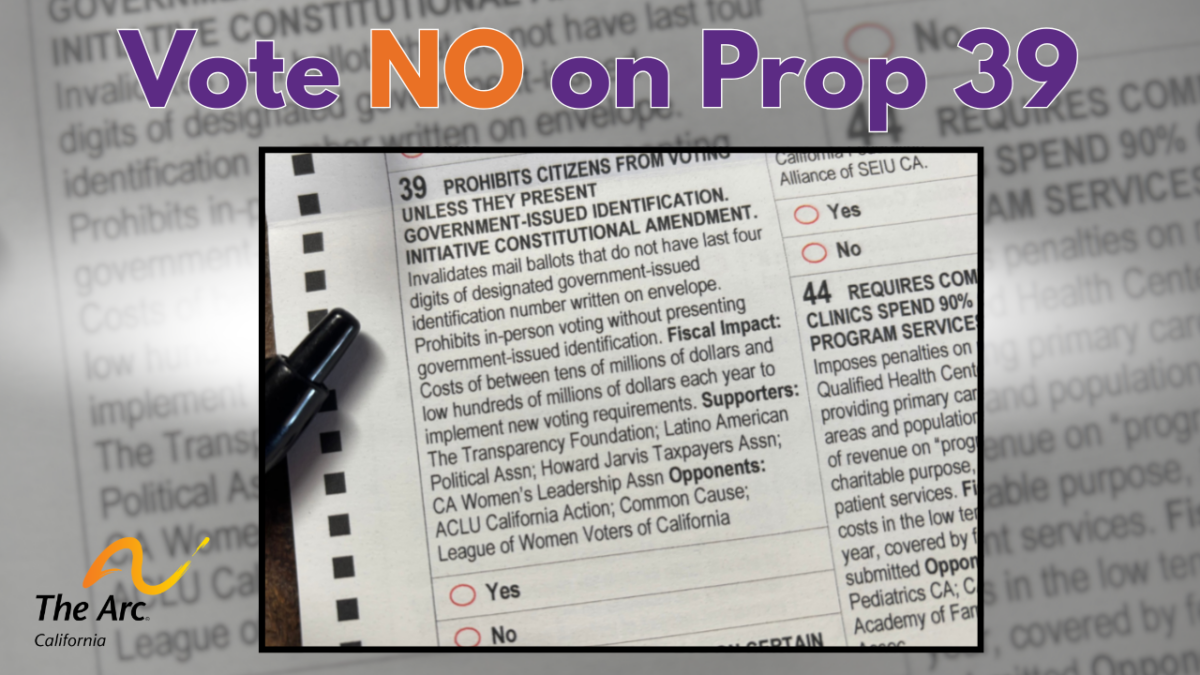
Every eligible Californian deserves the opportunity to vote independently, privately and without unnecessary barriers. That is why The Arc of California opposes Proposition 39 on the November 3 ballot.
The Arc of California supports secure, trustworthy elections. However, we believe Proposition 39 would create additional barriers for eligible voters, particularly people with intellectual and developmental disabilities who may already face challenges accessing the voting process.
Our position reflects our longstanding commitment to protecting the rights, independence and full community participation of people with disabilities. The right to vote is fundamental to that mission.
What would Proposition 39 change?
Proposition 39 would amend California’s Constitution to establish new voter identification requirements.
Under the measure:
-
-
- Voting in person: Voters would be required to present government-issued identification.
- Voting by mail: Voters would need to select a government-issued identification number for their voter registration and write the last four digits of that number on their ballot return envelope. The number would have to match their registration information.
- Free voter identification: The state would be required to provide a voter identification card at no cost to voters who request one.
- Citizenship verification and audits: Election officials would be required to make efforts to verify voters’ citizenship status, report their progress and undergo regular compliance audits.
-
The official ballot summary explains that a mail ballot would not count if the voter supplied digits from a different identification number than the one designated in their registration.
For The Arc of California, this raises an important concern: An eligible voter could lose their opportunity to have their ballot counted because of a paperwork mistake, not because they were ineligible to vote.
Why disability access matters
Voting barriers already exist for millions of Americans with disabilities.
Research published by the U.S. Election Assistance Commission in partnership with Rutgers University documents ongoing challenges, including inaccessible polling places, transportation difficulties and obstacles to voting independently.
For some people with disabilities, locating identification documents, completing additional paperwork or resolving an identification problem may require accessible transportation, communication support or assistance from another person.
Proposition 39 would provide a free state-issued voter identification card upon request. While eliminating the cost of the card is important, it does not necessarily eliminate the challenges associated with obtaining it.
The measure also leaves important implementation details to future legislation, including which forms of identification would qualify.
These concerns are not about a person’s ability to make voting decisions. Needing assistance with paperwork, transportation or communication does not diminish someone’s right or ability to choose their representatives and express their views.
California already has voter verification safeguards
California currently verifies identifying information during voter registration. Election officials also compare signatures on vote-by-mail envelopes with voter registration records before counting ballots. Certain first-time voters may be required to provide additional identification.
Supporters of Proposition 39 argue that additional identification requirements, citizenship verification and independent audits would strengthen election security and public confidence. They also emphasize that the measure would preserve voting by mail and provide free identification cards.
We recognize the importance of maintaining public trust in elections.
However, The Arc of California believes the additional requirements could create unnecessary obstacles for eligible voters without sufficiently addressing the accessibility concerns they raise.
There is also a financial consideration. According to the nonpartisan Legislative Analyst’s Office, implementing Proposition 39 could cost state and local governments tens of millions to low hundreds of millions of dollars annually, depending on how the measure is implemented.
Our position: Protect election integrity and voting access
The Arc of California believes election security and accessibility must go hand in hand.
Voting procedures should protect the integrity of elections while ensuring that eligible voters, including people with developmental disabilities, can participate fully and have their votes counted.
For these reasons, The Arc of California opposes Proposition 39.
We encourage all voters to review the proposal, understand the arguments on both sides and make informed decisions.
These resources provide additional information:
-
-
- California Easy Voter Guide – A nonpartisan guide from the League of Women Voters of California that explains ballot measures in plain language. Available in English, Spanish, Chinese, Korean and Vietnamese.
- California Secretary of State’s Quick Guide to Proposition 39 – A brief overview of what a yes or no vote would mean.
- Official Arguments For and Against Proposition 39 – Read the arguments submitted by supporters and opponents, including their responses to one another.
- Nonpartisan Legislative Analyst’s Review – An explanation of the measure, its proposed changes and estimated costs.
- Accessible Voting Resources – Information from the California Secretary of State about voting rights and accessible voting options for people with disabilities.
-
Election Day is Tuesday, November 3, 2026, and the last day to register to vote is Monday, October 19. Your voice matters. Your vote matters.