






 Search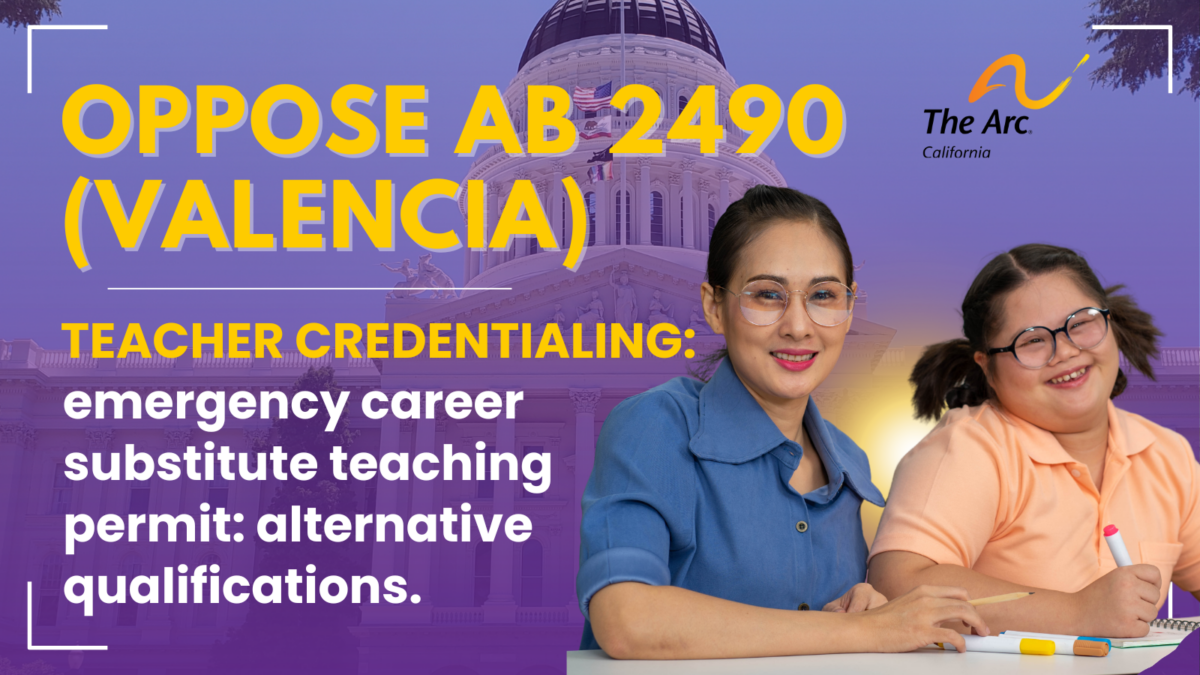
By Julie Schurman, Esq., Director of Public Policy, The Arc & UCP California Collaboration
California schools are facing a serious shortage of qualified teachers, including special education teachers. When a teacher takes an extended leave or a position remains vacant, schools can struggle to find someone who can provide students with consistent instruction.
We recognize that school districts are in a difficult position. Supporters of AB 2490 argue that allowing a substitute teacher to remain in the same classroom for a longer period could provide greater stability than repeatedly changing substitutes or leaving classrooms without consistent staffing.
However, The Arc of California believes AB 2490, introduced by Assemblymember Avelino Valencia, proposes the wrong solution. Addressing a shortage of qualified teachers by lowering the experience requirements for long-term substitute teachers could have serious consequences for students, particularly students with disabilities.
What Would AB 2490 Do?
Under current requirements, an applicant for an Emergency Career Substitute Teaching Permit generally must verify that they completed at least 90 days of substitute teaching in each of the three years immediately preceding their application.
AB 2490 would require the Commission on Teacher Credentialing (CTC) to accept an alternative pathway. Instead of meeting the substitute-teaching experience requirement, an applicant could qualify by completing:
-
-
- At least five hours of professional development
- An orientation training
- An assigned teaching mentor program
-
A substitute who qualifies through this alternative pathway could remain in one general or special education classroom for as many as 70 cumulative days during the school year. Because California’s instructional year is generally 180 days, this amounts to almost 40% of the school year.
The permit would be valid for 12 months. When renewing the permit for the first time, the substitute would need to provide verification of 30 hours of additional professional development.
The bill also includes some safeguards. Schools would have to provide specialized orientation and mentoring for substitutes working in special education classrooms, notify parents or guardians within 10 school days of the placement, make specified recruitment efforts before using this type of substitute, and publicly report information about extended substitute assignments.
While these provisions are intended to provide oversight, we do not believe they adequately address the central concern: five hours of professional development is not enough preparation to take responsibility for a special education classroom for nearly 40% of the school year.
Students With Disabilities Need Appropriately Prepared Teachers
Special education teachers do much more than deliver a standard lesson plan. They must understand and implement each student’s Individualized Education Program (IEP), provide appropriate accommodations, use specialized instructional strategies, address behavioral and communication needs, collaborate with families and service providers, and monitor progress toward individual goals.
Students may also depend on stability, routine, and educators who understand their individual needs. A substitute teacher with limited training may be placed in an extremely challenging position, even with access to a mentor.
Cindy Liu, a Ventura County parent whose daughter has Down syndrome and has had an IEP since kindergarten, explains the concern:
“This bill tells families like mine that a warm body is an acceptable substitute for a qualified teacher, for nearly 40% of the school year. AB 2490 pains me as a parent, and on behalf of the educators I respect. Five hours does not make a teacher.”
Research has consistently shown that access to qualified and experienced teachers is closely connected to student success. Students with disabilities, students from low-income families, and students of color are already more likely to be taught by inexperienced or underprepared educators. AB 2490 could deepen those disparities rather than address them.
Other Options Should Be Fully Considered
California already provides several pathways that school districts can use when they cannot find a fully credentialed teacher. Existing state law also allows a school district to seek approval to extend the length of a substitute assignment in a special education classroom when circumstances justify it.
This process provides flexibility while preserving additional oversight. Before creating a permanent and broadly available pathway for individuals with significantly less experience to serve in long-term assignments, the state should examine whether schools are fully using the staffing options that already exist.
AB 2490 also raises important questions about how its special education provisions would interact with federal personnel qualification requirements. The Individuals with Disabilities Education Act (IDEA) requires states to establish qualification standards for special education teachers and generally prohibits waiving special education certification requirements. California must uphold the personnel standards and protections established under the Individuals with Disabilities Education Act (IDEA) as these standards are not merely aspirational; they are essential safeguards for students with disabilities.
Teacher Shortages Require a Long-Term Solution
There is a real problem that AB 2490 is intended to address. Teacher shortages can disrupt classrooms, create uncertainty for students and families, and place additional pressure on educators and school administrators. Students may benefit from having one consistent adult in the classroom rather than a succession of short-term substitutes. However, AB 2490 does not guarantee that the same substitute will remain with a class throughout an extended absence or special educator vacancy, it simply allows an individual with an Emergency Career Substitute Teaching Permit to fill the vacancy for up to 40% of the school year. It therefore permits less experienced substitutes for both short and long term assignments.
The bill also has no sunset date, even though it has been presented as a temporary response to the current teacher shortage. If the expanded flexibility is intended to be temporary, it should not be placed into law indefinitely.
AB 2490 Is Not the Solution
Students need educators who have the preparation, qualifications, and support necessary to meet their needs. This is particularly important in special education classrooms. California should not respond to teacher shortages by attempting to weaken the federal qualification requirements designed to protect students with disabilities. Compliance with IDEA must remain the foundation of any proposed solution.
California should invest in recruiting, preparing, and retaining qualified special education teachers. The state should also ensure that schools understand and appropriately use the staffing pathways already available. Lowering the experience threshold for someone who may lead a Special Education classroom for almost 40% of the school year does not provide the lasting solution students deserve.
For these reasons, The Arc & UCP California Collaboration opposes AB 2490 and respectfully urges Governor Newsom to veto the bill.