





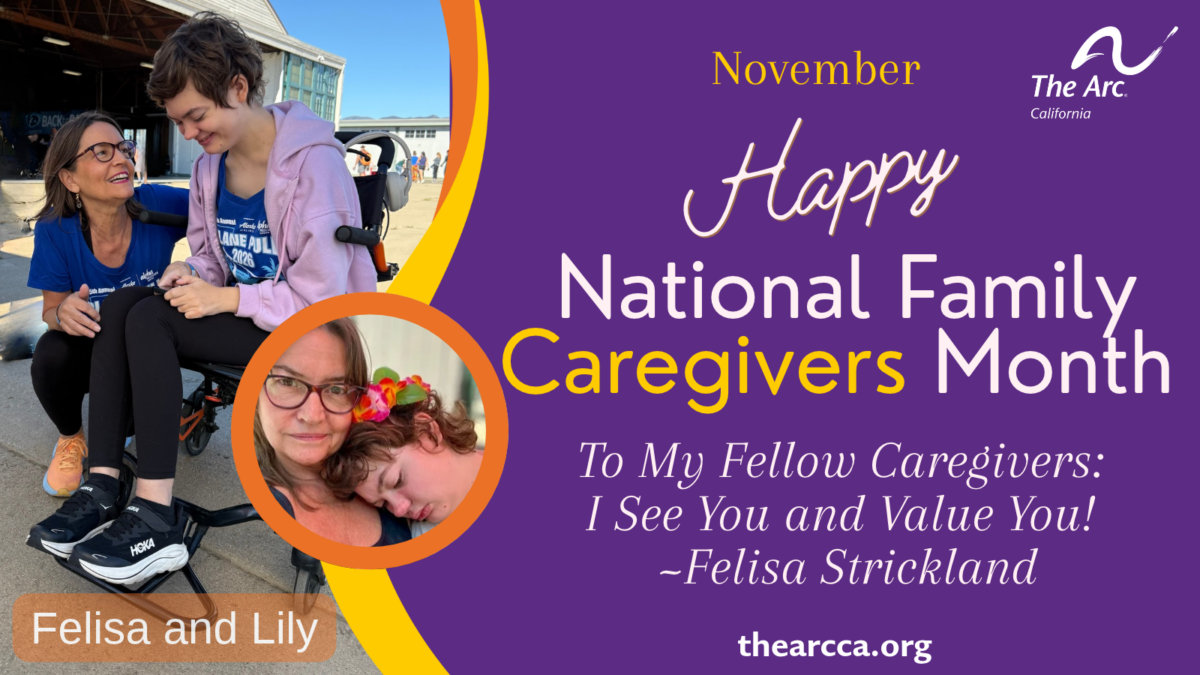
Recognizing the Love and Dedication of Family Caregivers

By Felisa Strickland, Parent-Educator and Secretary for The Arc of California Board of Directors

November is National Family Caregivers Month, so naturally, as a caregiver, I go into reflection mode and start to think, “What does that actually mean?” For me, and I am sure thousands of others, caregiving for my adult daughter Lily was not something I chose. It just became necessary, and I was the best person for the job. No matter how you get to it, though, the role of a caregiver comes with many hats to wear and a list of skills you never knew you had. It means balancing the hard work and commitment of daily care with respect for another person’s autonomy, comfort, and well-being. Many times, you are literally a lifeline. When you are a parent caring for your child with a disability, an adult child caring for a parent, a spouse caring for a spouse, or a sibling caring for a sibling, family ties add another layer to an already complex commitment.

All caregivers will tell you: there is no shortage of to-do lists when it comes to caregiving. Some of the most common tasks talked about are managing medications and specialized medical appointments, coordinating other services and supports, and providing personal care while continuously prioritizing comfort and dignity. Caregivers also navigate complicated government benefits, insurance policies, guardianships, and future and estate planning.

Caregivers play a huge role in actively seeking out and creating opportunities for social connection, hobbies, and personal choices to ensure that the person they care for has agency instead of just being a care recipient. This is especially true for family caregivers wanting to ensure that their loved one is living a full life with all the opportunities available to them. Caregivers serve as a steady source of unconditional safety and emotional stability for others. At the same time, many experience the unique grief, isolation, and burnout that often come with lifelong caregiving. I am one of those many. Caregivers need care, too: time to rest, tend to our own health, and ask for support. National Family Caregivers Month is a reminder that our well-being matters, too.

So, back to the original question …’What does National Family Caregivers Month actually mean?’ Well, to me, it means I get to share space with so many other parents who are lifelong caregivers, as well as caregivers in all kinds of families. I see them, and they see me. We navigate the complexities of this life and try to balance our love with our grief, our joy with our anguish. It means being grateful it can all be true at the same time. It’s feeling appreciative of all the caregivers who help me be a better caregiver even on the days I fall short, or they do. We couldn’t do it without each other. The life of a caregiver is surely undervalued, no doubt about it! And yet, I don’t underestimate how caregiving can illuminate the comfort, connection, and care that light our path the whole way. And lots of love, of course! Care is one of the most essential things we can do in this life.

If you are a caregiver, I see you and I thank you.

Where Caregivers Find Strength: The Transformative Power of Community

Guest Blog by Jessica Patay, Founder & Executive Director, We Are Brave Together, and Mom to Son Ryan, 22, with Prader-Willi Syndrome

Every day, millions of parents disappear. Not physically—as if erased by a magician’s wand—but swallowed by the sheer weight of caretaking tasks, medical appointments, insurance battles, school meetings, and navigating social-service systems. Somewhere between endless appointments, sleepless nights, and the desire to be “just a parent” while also functioning as a professional-level caregiver, we fade from view. We feel unseen. Hidden.

We are lonely, exhausted, overwhelmed, anxious, isolated, and grieving. We worry about finances. We worry about the future—especially the future our children will face when we are no longer here to care for them.

This is why National Family Caregivers Month matters.

It shines a light on the emotional, physical, and invisible labor carried every day by parent-caregivers. It reminds us that our experiences are real, that our load is heavy, and that support isn’t optional—it’s essential.

And this is where community changes everything.

At We Are Brave Together, when we talk about community for caregiving moms (our specific mission), we’re not talking about book clubs or casual girls’ nights out—though those have value, too.

    • We’re talking about survival.
    • We’re talking about being connected, empowered, and resourced.
    • We’re talking about mental health—protecting it, nurturing it, and honoring it—so we can continue to be the parents our children need.

Without community, that inner bully sneaks in, whispering, “You can’t do this. You’re not strong enough, smart enough, organized enough, patient enough.”

A loving community reminds us that we can do this extraordinary, demanding, beautiful, and sometimes messy parenting journey. Connection is part of the investment we are worthy of.

Isolation and loneliness are not signs of weakness—they are the predictable consequences of an extreme caregiving life. When we feel that deep ache of loneliness, it isn’t melodrama. It’s our brain signaling real distress. The beautiful part is that when we step into community, we are seen, supported, validated, and strengthened by people who genuinely “get it.”

In my early years as Ryan’s mom, I felt I had been dealt an unfair card. To be honest, I was resentful. I asked the questions many parents ask: Why me? Why my child? Why us? Why our family?

But being surrounded by other moms who understood my world helped shift my mindset. I felt cared for, not judged. My fears and thoughts were validated. I was quietly mentored by women who didn’t even realize they were guiding me.

That community moved me from a mindset of “why me?” to “what now?” And from that place, We Are Brave Together was born—a supportive, authentic community for mothers who are loving boldly, advocating fiercely, and finding resilience, joy, and gratitude even in chronic hardship.

And although our organization serves mothers specifically, my message is for every parent-caregiver: You deserve connection. You deserve support. You deserve a community that sees you.

As we honor National Family Caregivers Month, may we come together with kindness and compassion—lifting one another up, easing the loneliness, and offering friendship to those walking a similar path.

You are not meant to do this alone. We are braver when we walk together.

Celebrating the Love and Strength of Family Caregivers

By Felisa Strickland, Parent-Educator for Caring Futures, The Arc of California Board Member, and caregiver to daughter Lily

November is National Family Caregivers Month — a time to honor the millions of parents, family members, and friends who provide care and support to loved ones with disabilities, chronic illnesses, or age-related needs. It’s also a time to reflect on the shared strength, resilience, and love that bind caregiving families together.

Twenty-five years ago, when I became a mother to my daughter Lily, I did not know that my title of “Mom” would also be shared with that of “caregiver.” In fact, it took many years for me to see that as an accurate description of the love and care I provide for Lily. But like so many of you, I have been doing it for a long time, and it has changed over the years, from the basic care you provide your children as they grow up, to a lifetime of support.

I have developed into my role and learned to navigate the twists and turns that come with day-to-day care. I am proud to be my daughter’s caregiving mother. I am grateful for the relationship I have with her, and the joy of caring for her has enhanced my life. We are best friends, and like most best friends, we have our ups and downs, good days and bad days.

Sometimes being her caregiver is very hard work. It carries a ton of responsibility, uncertainty, worry, and fear that multiplies repeatedly as a parent. As the years go by, I have learned that I can’t do it alone. I am grateful to the parents who came before me, showed me the ropes and offered guidance and support. I am also getting tired and wonder about our future — Lily’s, and mine.

Two years ago, I got involved with The Arc of California’s Caring Futures program, a community for parents and caregivers who support a family member with disabilities. The program, which is still going strong, offers future planning classes, self-care classes, a webinar series, a resource library, and a private Facebook community. It has been an honor to be a part of it all since the beginning. We are celebrating the program’s two-year anniversary this month — during National Family Caregivers Month — and we are celebrating with YOU!

As parents and caregivers of someone with disabilities, we know there are many rewards to the love and care you provide. But we also know that it isn’t always easy, and it doesn’t always come with recognition or the supports and services we really need. That’s where Caring Futures comes in… we see you! We want you to know you are not alone. There is a community here for you, and we recognize all you do for your child, family, and community. We are so glad you are part of the Caring Futures family.

We hope you will make a special point to celebrate yourselves this month for all you do, and for the abundance of love you provide to others. This month is a reminder to pause and recognize all the other caregivers in our lives who have helped us along the way to be the best we can be, and to remember that our best is good enough. It truly does take a village, and we are so happy you are part of ours.