





Understanding the DDS Proposal on Equitable Access to Intake and Services

By Julie Schurman, Esq., Director of Public Policy, The Arc & UCP California Collaboration

The California Department of Developmental Services (DDS) has introduced a proposal known as Equitable Access to Intake and Services as part of this year’s deferred budget trailer bill process. While California’s state budget has already been enacted, several complex policy proposals were intentionally deferred until August to allow for additional legislative review, stakeholder input, and public testimony before any final decisions are made.

On August 5, 2026 the Assembly Budget Subcommittee No. 2 on Human Services held a public hearing on the proposal, giving legislators, DDS, advocates, regional centers, self-advocates, family members, and service providers an opportunity to discuss the proposal and ask questions before moving forward.

Why was this proposal introduced?

According to DDS, the proposal is intended to make California’s developmental services system more equitable and consistent across all 21 regional centers.

Today, regional centers use different practices when determining whether an applicant meets the statutory definitions of a developmental disability and substantial disability. Likewise, after a person becomes eligible for services, regional centers use the Client Development Evaluation Report (CDER) differently to assess an individual’s strengths and support needs.

DDS argues that these variations can result in inconsistent experiences depending on where someone lives. The proposal seeks to establish more standardized statewide processes while maintaining the individualized, person-centered planning required under the Lanterman Act.

What would the proposal do?

The proposal contains two major components.

    1. Create a standardized intake eligibility assessment

The proposal would establish a single statewide assessment process for determining whether applicants meet the existing eligibility criteria for regional center services.

Importantly, DDS emphasized throughout the hearing that this does not change who is eligible for services. Instead, it standardizes how the existing eligibility criteria are evaluated.

The proposal also requires stakeholder engagement before any assessment process is finalized, and the Legislature would have to approve the final assessment before implementation.

   2. Replace the CDER with a modern strengths and needs evaluation

The second component would replace the current Client Development Evaluation Report (CDER) with a new strengths- and needs-based assessment.

DDS noted that the CDER is now approximately 50 years old and has undergone only minor revisions during that time. Chair Corey Jackson observed during the hearing that our understanding of disability, assessment practices, and service delivery has evolved significantly over the past five decades, making it appropriate to examine whether a more modern approach is warranted.

The proposed evaluation would be designed to provide better information about an individual’s strengths, goals, and support needs to assist Individual Program Plan (IPP) teams during person-centered planning.

What would not change?

One of the recurring themes throughout the hearing was clarifying what the proposal does not do.

DDS repeatedly stated that the proposal:

      • Does not change the statutory definitions of developmental disability or substantial disability.
      • Does not replace the Individual Program Plan (IPP).
      • Does not determine what services a person receives.

DDS explained that, much like the CDER today, the new assessment would simply provide information to support the IPP process. Decisions about services would continue to be made collaboratively by the individual and their IPP team.

Key themes from the hearing:

A number of important themes emerged during the legislative hearing.

Chair Corey Jackson emphasized that there is no assessment tool currently being adopted. Rather, the Legislature is being asked whether DDS should move forward with developing and studying a new assessment process. Some have referred to the proposal as functioning much like a “study bill,” since the actual assessment tool has not yet been selected or developed.

DDS indicated that there is no preconceived decision regarding what the eventual assessment will look like. The Department stated it intends to examine assessment models used in other states, consider whether an existing tool could be adapted, evaluate whether California should develop its own assessment, or potentially combine elements of multiple approaches. DDS stressed that stakeholder input will play an important role throughout that process.

Several advocates also noted that numerous assessment models exist nationally and encouraged DDS to carefully examine those experiences before selecting any approach.

At the same time, advocates emphasized that any future assessment must be carefully designed and implemented because it could have significant impacts on individuals and families if not done correctly.

The hearing also highlighted the importance of ensuring any future assessment is both valid and reliable, meaning different evaluators should reach consistent conclusions when assessing the same individual.

What happens next?

The August 5 hearing represented the beginning of a broader public consultation process. The Department has committed to working with stakeholders to develop and evaluate possible assessment approaches before returning to the Legislature for approval of any final assessment tool. Additional opportunities for public engagement are expected throughout that process.

The Arc of California encourages everyone interested in the proposal to review the available materials, watch the legislative hearing, and participate in future stakeholder discussions as the proposal continues to develop.

El Arc de California’s Community Advocacy Initiative Drives New Statewide Transparency Measures

Over the past year, from January 2025 through February 2026, the El Arc de California team and its statewide network of advocates expanded advocacy training, outreach, and community engagement for families across California. This work focused on empowering parents and caregivers of children and youth with developmental disabilities—ensuring families have the knowledge, tools, and support needed to advocate for the services their children need to thrive. This work was made possible in part through support from The Lucile Packard Foundation for Children’s Health.

Throughout the year, El Arc de California prioritized increasing access to advocacy education—particularly for Spanish-speaking families who often face barriers to participating in policy conversations. In September 2025, the team launched a bilingual Advocacy Academy webinar series to help families understand their rights, navigate services, and engage confidently in advocacy. Each session was offered in Spanish with English and ASL interpretation, with recordings available for continued learning. The series reached more than 600 registered participants, with an average of 150 attendees joining live per session—demonstrating strong statewide demand for accessible, culturally responsive advocacy training.

Through bilingual newsletters, targeted email outreach, social media, and partnerships with community organizations, El Arc de California reached thousands of families across the state and welcomed many parents into advocacy spaces for the first time. Families gained practical tools to actively participate in Individual Program Plan (IPP) meetings, communicate with decision-makers, and advocate for critical services. This level of engagement highlights the importance of building accessible pathways for families to step into leadership roles within their communities.

In April, El Arc de California convened a statewide gathering of more than 50 organizations as part of the El Arc leadership coalition. Together, participants worked to develop a unified message around services and supports for Latino children with developmental disabilities and to advance equity across California’s developmental services system. This effort focused on strengthening the capacity of Latino community leaders to communicate effectively, mobilize families, and drive collective action. As part of this initiative, a digital advocacy toolbox is being developed with shared resources—including letters to legislators, media templates, social media content, and outreach materials—to support coordinated advocacy efforts statewide. This work contributed to a statewide campaign that gathered more than 1,700 signatures in support of AB 1220 (Arambula).

Building on this momentum, the El Arc de California advocacy network played a central role in advancing AB 1220, legislation sponsored by the organization to increase transparency and accountability in California’s developmental services system. Parents and advocates who participated in trainings elevated the urgent need for clearer documentation when services are denied or delayed. Families shared their lived experiences, engaged directly with policymakers, and organized within their communities to push for systemic change.

Although AB 1220 did not ultimately pass, the collective advocacy behind it led to a significant outcome. At the end of 2025, the California Department of Developmental Services issued a statewide directive requiring regional centers to track and publicly report data on service denials, disagreements, and notices of action.
Learn more: https://thearcca.org/from-advocacy-to-action-dds-will-now-track-and-report-service-denials/

This directive marks a historic step toward transparency and accountability—creating, for the first time, a statewide mechanism to understand patterns of service denials and strengthen families’ ability to advocate effectively. It reflects the power of sustained, community-driven advocacy.

In December, the Latino Disability Leadership Summit provided an opportunity to bring together coalition leaders, parents, and self-advocates to reflect on this work and the progress achieved. The summit served as a moment to recognize the journey from training and organizing to policy impact, while also setting a shared vision for the next phase of advocacy focused on advancing equity and improving access to services for Latino children and families across California.

Across all of this work, one theme remained clear: when families are informed, connected, and supported, they become powerful advocates for change. This year strengthened a growing network of parents and community leaders who are not only navigating systems—but actively shaping them.

The Arc de California extends its appreciation to community members who participated, shared their stories, and took action throughout the year, continuing to move this work forward.

DDS Director Nancy Bargmann Announces Retirement

After more than 40 years of serving Californians with developmental disabilities in various roles, Nancy Bargmann, Director of the California Department of Developmental Services (DDS) announces her retirement.

Bargmann, who began her role as Director in 2016, said she will begin retirement the first of September in a public announcement on Wednesday, July 24. In her announcement she also noted some key accomplishments during her eight-year tenure.

“Together, we closed all of California’s developmental centers while building inclusive community services. We faced and withstood a pandemic, ushered in unprecedented growth, and expanded person-centered services and supports to a growing and diverse population from 300,000 in 2016 to over 440,000 today,” Bargamm wrote.

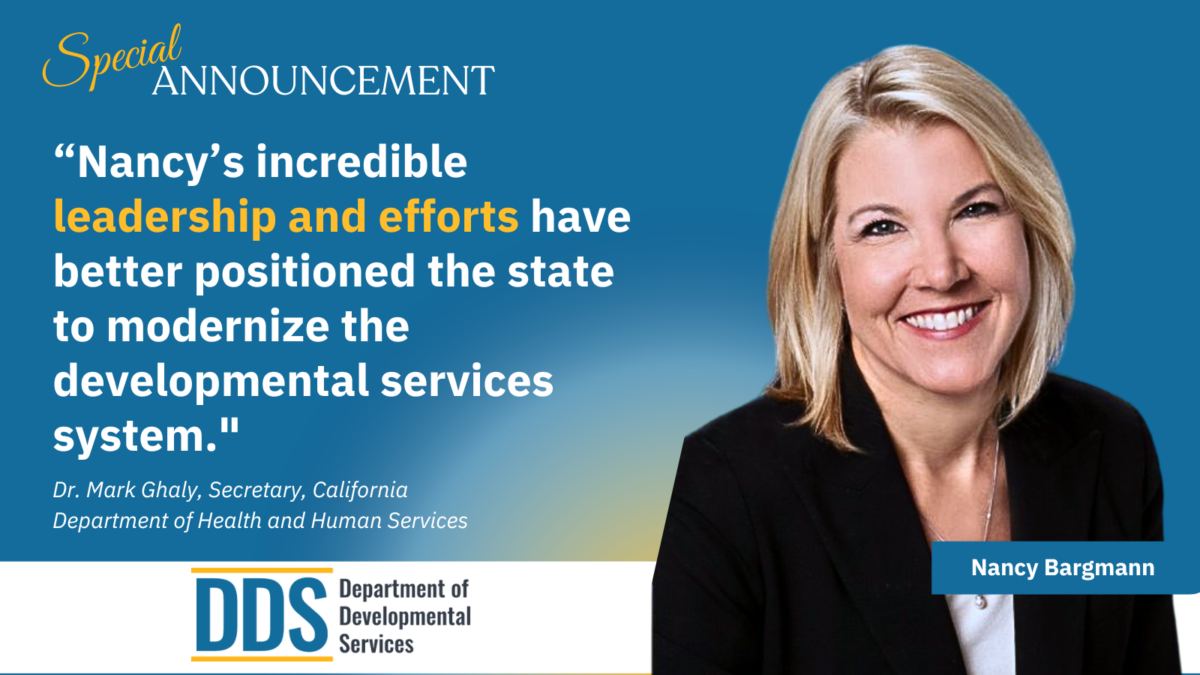
In a statement made from Dr. Mark Ghaly, Secretary for the California Department of Health and Human Services, thanking Bargmann for her many years of service and commitment, he wrote “Nancy’s incredible leadership and efforts have better positioned the state to modernize the developmental services system through the development of California’s Master Plan for Developmental Services and the implementation of the rate study. The Newsom Administration is committed to continuing this important work, with the final Master Plan to be released in March of 2025.”

Bargmann began her career as a Direct Support Professional (DSP) in 1984. She went on to hold several positions and leadership roles at regional centers, service providers, and the State, including as associate executive director at San Gabriel/Pomona Regional Center and deputy director of the Community Services Division at DDS. Bargmann was appointed Director of DDS on March 4, 2016, by former Governor Edmund G. Brown Jr. and reappointed in 2020 by Governor Gavin Newsom.

“Throughout the years as Director of DDS Nancy demonstrated her administrative and political skills, but it was clear to all that she never forgot her social work background, said Jordan Lindsey, Executive Director, The Arc of California. “She will certainly leave behind a legacy of collaboration and community involvement.”