By Julie Schurman, Esq., Director of Public Policy, The Arc & UCP California Collaboration
The Arc of California joins The Arc of the United States and disability rights organizations across the country in opposing the proposed resolution of Texas v. Kennedy, which would remove important community integration protections from federal Section 504 regulations.
On August 31, 2026, the U.S. Department of Health and Human Services (HHS), joined Texas, Florida, and Alaska in asking a federal court to remove community integration provisions from HHS’s 2024 Section 504 regulations.
These regulatory protections help put into practice the right of people with disabilities to live and receive services in their own homes and communities rather than being unnecessarily segregated in institutions.
The proposed resolution is significant, but it does not overturn the Supreme Court’s decision in Olmstead v. L.C. or change the Americans with Disabilities Act (ADA) or Section 504 of the Rehabilitation Act. Those protections remain federal law.
What is Texas v. Kennedy?
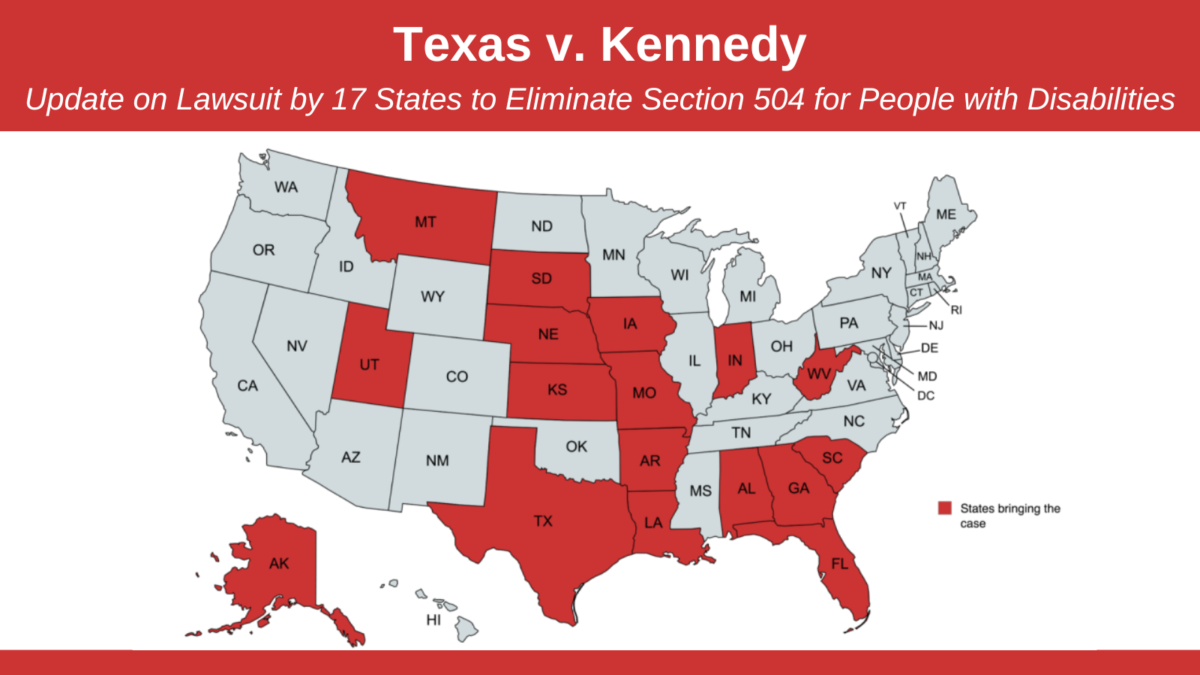
Texas v. Kennedy, previously called Texas v. Becerra, began in 2024 when a group of 17 states led by Texas sued HHS over updated regulations implementing Section 504 of the Rehabilitation Act.
Section 504 is one of the nation’s foundational disability civil rights laws. It prohibits disability discrimination by programs and organizations that receive federal financial assistance.
In 2024, HHS completed the first major update to its Section 504 regulations in decades. The new rule strengthened and clarified protections for people with disabilities in health care and human services. Among other things, the rule:
-
- Established enforceable accessibility standards for medical diagnostic equipment, including examination tables and weight scales.
- Established accessibility requirements for websites and mobile applications used by recipients of HHS funding, which are particularly important for people who use screen readers and other assistive technology.
- Strengthened protections against disability discrimination in child welfare programs, including protections for parents, caregivers, foster parents, and prospective parents with disabilities.
- Clarified protections against disability discrimination in medical treatment.
- Strengthened and clarified requirements concerning community integration, including protections for people with disabilities who are unnecessarily institutionalized or placed at serious risk of institutionalization.
You can learn more about these protections in HHS’s 2024 Section 504 Final Rule.
The lawsuit originally went much further than the integration provisions. The original 17-state lawsuit challenged the updated regulations and included a claim challenging the constitutionality of Section 504 itself. The case changed substantially over time. The states later dropped their effort to have Section 504 declared unconstitutional, several states withdrew from the litigation, and the dispute ultimately narrowed to the community integration provisions.
What is the integration mandate?
The integration mandate is a longstanding principle of federal disability law protecting people with disabilities from unnecessary segregation.
In the landmark 1999 Supreme Court decision Olmstead v. L.C., the Court held that unjustified segregation of people with disabilities can constitute discrimination under Title II of the ADA.
Under Olmstead, public entities must provide community-based services when those services are appropriate, the person does not oppose receiving services in the community, and the services can be reasonably accommodated considering available resources and the needs of others receiving disability services.
These protections have played an important role in helping people with disabilities live and receive services in their own homes and communities instead of being unnecessarily segregated in institutions.
Federal Government’s Change in Position on Community Integration
On June 18, 2026, Department of Justice Office of Legal Counsel issued a new legal opinion taking a different position on the integration mandate and the federal government’s authority to enforce it through regulation.
The Department of Justice Office of Legal Counsel concluded that neither Section 504 nor Title II of the ADA itself imposes an integration mandate on states and that federal agencies do not have authority under those statutes to impose an integration mandate through regulation.
You can read the June 18 DOJ Office of Legal Counsel opinion here.
This represents a significant reversal of the federal government’s longstanding interpretation of federal disability law. As The Arc of the United States and other national disability rights organizations have explained, federal Section 504 regulations have included integration provisions since 1977.
It is also important to understand what the Department of Justice Office of Legal Counsel opinion does not do. A Department of Justice Office of Legal Counsel opinion states the Executive Branch’s legal position. It is not a Supreme Court decision and does not itself overturn Olmstead or other judicial precedent. The opinion itself acknowledges that its interpretation is “out of step” with how courts across the country have interpreted the law.
What is the proposed resolution in Texas v. Kennedy?
Rather than defending HHS’s 2024 community integration regulations, HHS joined the remaining states in asking the federal court to enter a final judgment resolving the case.
Under the proposed judgment, the court would remove the entire integration provision at 45 C.F.R. § 84.76 from the 2024 Section 504 HHS regulations. It would also remove the definition of “most integrated setting” and other references to community integration throughout those regulations.
The proposed resolution is limited to these community integration provisions. It does not eliminate the other important protections contained in the 2024 Section 504 rule, including provisions addressing accessible medical equipment, web and mobile accessibility, discrimination in child welfare programs, and discrimination in medical treatment.
Importantly, as of September 4, this remains a proposed judgment that the parties have asked the court to enter. The court must still act on the joint motion.
You can read the Corrected Joint Motion for Entry of Final Judgment here.
What does this mean for the integration mandate?
The proposed resolution does not overturn Olmstead. It does not repeal or amend the ADA or Section 504. And it does not erase decades of court decisions interpreting the rights of people with disabilities to receive services in integrated settings. However, if the court enters the proposed judgment, it would remove important community integration language from HHS’s Section 504 regulations. That matters because federal regulations help translate civil rights laws into concrete requirements and provide a framework for federal enforcement.
Why this matters
For decades, the disability rights movement has fought against the unnecessary segregation and institutionalization of people with disabilities. People with disabilities should have the opportunity to live, work, receive services, and participate in their communities alongside people without disabilities.
Removing the community integration provisions from HHS’s Section 504 regulations would weaken an important federal tool for putting those rights into practice.
The Arc of California joins The Arc of the United States and national disability rights organizations in opposing efforts to roll back community integration protections. We will continue to follow Texas v. Kennedy and advocate for the right of people with disabilities to live and receive services in their communities.







 Search