





El Arc de California’s Community Advocacy Initiative Drives New Statewide Transparency Measures

Over the past year, from January 2025 through February 2026, the El Arc de California team and its statewide network of advocates expanded advocacy training, outreach, and community engagement for families across California. This work focused on empowering parents and caregivers of children and youth with developmental disabilities—ensuring families have the knowledge, tools, and support needed to advocate for the services their children need to thrive. This work was made possible in part through support from The Lucile Packard Foundation for Children’s Health.

Throughout the year, El Arc de California prioritized increasing access to advocacy education—particularly for Spanish-speaking families who often face barriers to participating in policy conversations. In September 2025, the team launched a bilingual Advocacy Academy webinar series to help families understand their rights, navigate services, and engage confidently in advocacy. Each session was offered in Spanish with English and ASL interpretation, with recordings available for continued learning. The series reached more than 600 registered participants, with an average of 150 attendees joining live per session—demonstrating strong statewide demand for accessible, culturally responsive advocacy training.

Through bilingual newsletters, targeted email outreach, social media, and partnerships with community organizations, El Arc de California reached thousands of families across the state and welcomed many parents into advocacy spaces for the first time. Families gained practical tools to actively participate in Individual Program Plan (IPP) meetings, communicate with decision-makers, and advocate for critical services. This level of engagement highlights the importance of building accessible pathways for families to step into leadership roles within their communities.

In April, El Arc de California convened a statewide gathering of more than 50 organizations as part of the El Arc leadership coalition. Together, participants worked to develop a unified message around services and supports for Latino children with developmental disabilities and to advance equity across California’s developmental services system. This effort focused on strengthening the capacity of Latino community leaders to communicate effectively, mobilize families, and drive collective action. As part of this initiative, a digital advocacy toolbox is being developed with shared resources—including letters to legislators, media templates, social media content, and outreach materials—to support coordinated advocacy efforts statewide. This work contributed to a statewide campaign that gathered more than 1,700 signatures in support of AB 1220 (Arambula).

Building on this momentum, the El Arc de California advocacy network played a central role in advancing AB 1220, legislation sponsored by the organization to increase transparency and accountability in California’s developmental services system. Parents and advocates who participated in trainings elevated the urgent need for clearer documentation when services are denied or delayed. Families shared their lived experiences, engaged directly with policymakers, and organized within their communities to push for systemic change.

Although AB 1220 did not ultimately pass, the collective advocacy behind it led to a significant outcome. At the end of 2025, the California Department of Developmental Services issued a statewide directive requiring regional centers to track and publicly report data on service denials, disagreements, and notices of action.
Learn more: https://thearcca.org/from-advocacy-to-action-dds-will-now-track-and-report-service-denials/

This directive marks a historic step toward transparency and accountability—creating, for the first time, a statewide mechanism to understand patterns of service denials and strengthen families’ ability to advocate effectively. It reflects the power of sustained, community-driven advocacy.

In December, the Latino Disability Leadership Summit provided an opportunity to bring together coalition leaders, parents, and self-advocates to reflect on this work and the progress achieved. The summit served as a moment to recognize the journey from training and organizing to policy impact, while also setting a shared vision for the next phase of advocacy focused on advancing equity and improving access to services for Latino children and families across California.

Across all of this work, one theme remained clear: when families are informed, connected, and supported, they become powerful advocates for change. This year strengthened a growing network of parents and community leaders who are not only navigating systems—but actively shaping them.

The Arc de California extends its appreciation to community members who participated, shared their stories, and took action throughout the year, continuing to move this work forward.

From Advocacy to Action: DDS Will Now Track and Report Service Denials

Families across California have long raised concerns about service denials, notices of action, and disagreements during Individual Program Plan (IPP) meetings—often with little documentation or transparency to support informed advocacy.

In 2025, El Arc de California worked alongside Assemblymember Dr. Joaquin Arambula to advance AB 1220, legislation aimed at improving transparency by requiring service denials, notices of action, and appeals to be documented, tracked, and publicly reported. While AB 1220 did not pass out of the Legislature, the advocacy behind it sparked meaningful change.

On December 31, the California Department of Developmental Services (DDS) issued a statewide directive requiring regional centers to begin collecting and reporting detailed data on service disagreements, denials, and notices of action that occur during IPP meetings—information that has never before been systematically tracked or made public. Starting with the 2026–27 fiscal year, this data will be compiled annually, with public reporting beginning in December 2027.

In this week’s Arc Beacon, Joe Perales, Director of El Arc de California, breaks down why this directive is a historic milestone for families, advocates, and the disability community—and how collective advocacy helped move the system forward, even without a bill becoming law.

Watch the full Arc Beacon video to learn why this win matters and what comes next.

Families Deserve Answers—Help Ensure AB 1220 Moves Forward

California’s 21 Regional Centers play a vital role in supporting individuals with developmental disabilities and their families. As families navigate these essential services, many still encounter challenges understanding decisions about service eligibility and how to respond when services are not approved.

AB 1220, authored by Assemblymember Dr. Joaquín Arambula, seeks to strengthen the developmental services system by:

    • Requiring that denials, notices of action, and appeals be documented in the Individual Program Plan (IPP)
    • Ensuring that this information is tracked and publicly reported by the Department of Developmental Services
    • Promoting greater transparency and consistency so families are better equipped to make informed decisions and advocate with confidence

CURRENT STATUS (JULY 2025)

AB 1220 passed the Assembly Human Services Committee, full Assembly, and Senate Human Services Committee. The bill is now in the Senate Appropriations Committee’s “Suspense File” for fiscal review.

A decision will be made after the Legislature returns from Summer Recess on August 18 on whether the bill will move forward.

NOW IS THE TIME TO ACT

We still have a critical opportunity to help move AB 1220 forward, and your voice matters.

Sign the Open Letter to the Senate Appropriations Committee and its Chair to show widespread community support:

Watch the AB 1220 Hearing: https://www.assembly.ca.gov/media/assembly-human-services-committee-20250429

WHY THIS BILL MATTERS

    • “AB 1220 gives our communities the power of visibility, and that’s how real change begins,” said Joe Perales, Director, El Arc de California
    • “Transparency is essential to equity. Our communities deserve to know when services are denied and why,” said Assemblymember Dr. Joaquín Arambula

Let’s keep working together to ensure families have the information and tools they need to thrive. Join us in supporting AB 1220. TAKE ACTION NOW!

El Arc de California Leads Historic Advocacy Effort for Transparency and Equity in California

By Joe Perales, Director, El Arc de California

Last week, El Arc de California organized a powerful two-day Latino Disability Leadership Summit, bringing together over 53 Latino leaders from across California. Representing more than 50 community-based organizations and groups, these advocates united to push forward AB 1220 (Arambula), a landmark bill aimed at increasing transparency and accountability in the state’s developmental services system.

AB 1220, authored by Assembly Member Dr. Joaquín Arambula (D-Fresno), passed out of the Assembly Human Services Committee with a unanimous vote, and now heads to the Appropriations Committee. This is a historic win for California’s disability rights movement and marks the first time in the state’s history that legislation requiring California’s Regional Centers to document and publicly report service denials, notices of action and appeals, has advanced through committee.

The summit opened with remarks from Assembly Member Arambula and Dr. Michi Gates, Chief Deputy Director of the California Department of Developmental Services (DDS). Both recognized the power and leadership of the Latino disability community in advocating for systemic change.

Advocates received hands-on training from Chris Arroyo, Assistant Director of Policy and Public Affairs at the State Council on Developmental Disabilities, learning how to craft compelling testimony, organize their communities, and use their personal stories to drive change. And Jorda

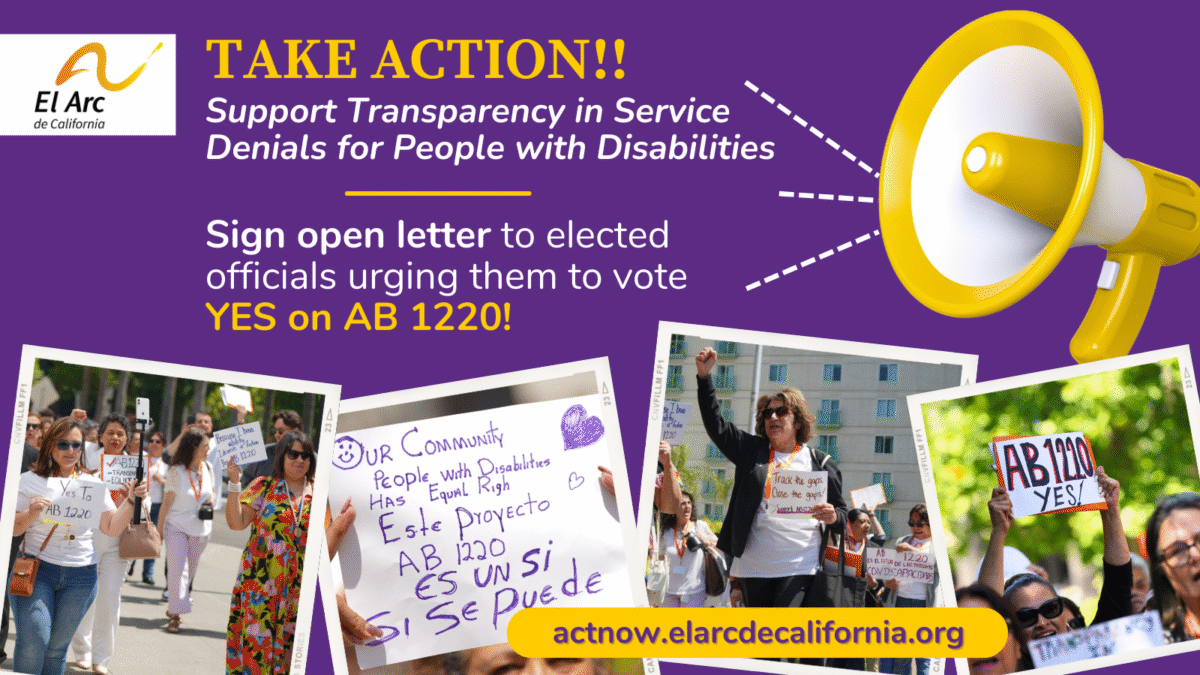
The group of leaders, which included adults with developmental disabilities, their family members and allies, put their training into action. With their rally signs and voices united, the group took to the streets chanting “¡Latinos unidos jamás serán vencidos!”(Latinos united will never be defeated) as they marched toward the legislative building to testify at the Assembly Human Services Committee Hearing in support of AB 1220. 

Across California, Latino families are being denied critical services for their family member with a developmental disability— and too often, they aren’t told why or what they can do about it. AB 1220 addresses this barrier to accessing services.

El Arc Coalition leaders and community members delivered passionate public comments inside the hearing. Families and advocates shared honest and emotional testimonies rooted in truth.

Ana Alonso, a parent of three children with disabilities and advocate from Kern County, said “As a mother, I know the importance of access to services, which makes a difference in our lives. Transparency when services are denied is important to the family. The disability doesn’t go away because services are denied.  The need is still there.”

“This bill is about fairness. Every family deserves to understand what decisions are being made about their child’s care, and why,” said Patricia Albeño, parent of an young-adult with disabilities, and disability rights advocate.”This bill gives us the tools we need to advocate for our loved ones.” 

This is not just progress — it is a milestone in the movement for racial equity, disability justice, and accountability. The voices of Latino families, self-advocates, community leaders, and the El Arc Coalition helped move this bill forward. 

We are grateful for the support of the Human Services Committee Members, and will continue to advocate for passage of AB 1220 as it moves through the legislative process to become law. 

AB 1220 gives our communities the power of visibility — and that’s how change begins.

To show support for this landmark legislation, you can sign onto an Open Letter to our Elected Officials.  We want to get at least 5,000 signatures. It only takes two minutes to add your name: Click HERE for English and click HERE for Spanish.  

  • To watch the hearing and testimony, click HERE
  • To view photos from the summit, click HERE